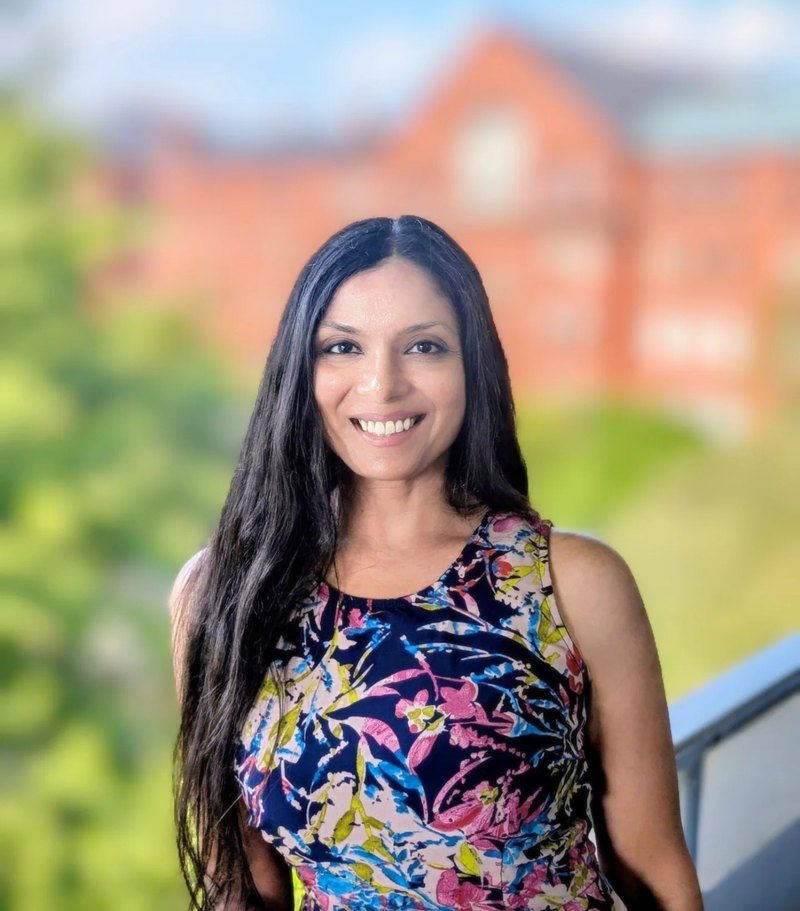
Lekshmi Radhakrishnan
Research Assistant, Cultural Dynamics Lab
ALM candidate in Psychology, Harvard University
Many people never seek therapy because they expect to spend it explaining themselves rather than being helped.
I'm interested in how the interpretive frames people inherit — transmitted across generations rather than chosen — shape the way psychological distress is recognized and treated. My focus is classification accuracy: cultural distance between clinician and patient can produce error in both directions, pathologizing what is culturally ordinary and missing genuine illness expressed in unfamiliar terms. The pattern is well documented in psychotic-spectrum illness, where diagnostic and treatment disparities across racial and ethnic groups are established, and that is also where my clinical grounding lies.
That question isn't abstract for me. I grew up between Kerala and the United States, and I have spent most of my life watching people in one culture fail to make sense of perspectives that another treats as obvious. In clinical work, that gap has consequences: people decide the explaining isn't worth it, and quietly go without care.
My personal questions and clinical experience found a framework while I was working with Dr. Mona Weissmark on Seeing the Other Side: Shifting Perceptions, on the psychology of perspective-taking across group and cultural lines. It gave me a way to think about what it takes to see from another position, and introduced me to research on transgenerational trauma and on why certain frames are so hard for people to step outside.
Clinical background
For two years I managed a residential facility run by the Mental Health Association of South Central Kansas, home to more than 30 adults with chronic psychiatric conditions, most on the psychotic spectrum. A substantial number of residents were immigrants, and many spoke little or no English. It is the reason I think about assessment the way I do: I have watched what happens when a clinician and a patient do not share a frame for what is being described.
Languages
I speak English, Malayalam, Tamil, and Hindi, and can recruit, interview, and run fieldwork in South Asian and diaspora communities without an interpreter.
Research
My training so far spans four levels of the problem: culture, clinical phenomena, structure, and biology. A person who is misread in a clinic, or who never reaches one, is being acted on at all four at once, and I don't think you can fix the problem from any one level alone.
Cultural Dynamics Lab — Joshua Conrad Jackson
Research Assistant · September 2026 – presentHow historical and social change reshapes emotion, moral judgment, and belief — including when people fall back on abstract social categories to read each other. The upstream question: what is culture actually doing to the mind?
McNally Lab — Richard J. McNally
Thesis student and Research Assistant · 2026 – presentAnxiety and obsessive-compulsive spectrum conditions in the perinatal period, measured in daily life through ambulatory assessment and heart rate variability.
Center for Bioethics, Harvard Medical School — Rachel C. Conrad
Research Assistant · 2023 – 2024Who can reach care at all. I helped refine and run a multi-state study of how licensure law limits students' access to psychiatric treatment, and presented the findings to state medical boards and health policy groups.
Hecht Lab & Surbeck Pan Lab — Erin Hecht, Martin Surbeck
Research Assistant, Hecht Lab · 2024 – 2026 · Research Affiliate, Pan Lab · 2025 – 2026Comparative neuroscience and primatology of social bonding — where our claims about human nature come from, and how much weight they can carry. Human and canine MRI acquisition, including pediatric protocols.
Teaching
Publications
Peer-reviewed
Conrad, R. C., Koire, A., Radhakrishnan, L., Charroux, A., Klingler, S., Benson, N. M., & Boyd, J. W. (2025). Impact of state medical licensure exemptions and telehealth registries on college students' access to psychiatric care. Psychiatric Services, 76(6), 602–605. doi:10.1176/appi.ps.20240225 Covered in Psychiatric News Alert, February 2025.
Under review
Hecht, E. E., Rogers Flattery, C., Abdulla, M., Michlich, J., Radhakrishnan, L., Dooyema, J., Chavez Flores, A., Swardstrom, R., Rogers, F., Helen, J., Althammer, F., Kukekova, A. V., & Sherwood, C. C. Hypothalamic oxytocin and vasopressin cell populations do not differ across selectively-bred silver fox lineages but covary with brain-wide structural organization. Journal of Comparative Neurology, revised manuscript resubmitted September 2026. I performed the stereological quantification and brought the cell-counting project to completion.
In preparation
Cross-lagged panel network analysis of ecological momentary assessment data on obsessive-compulsive symptoms in the perinatal period. Coauthor, McNally Lab.
Invited policy briefings
Radhakrishnan, L., & Conrad, R. C. (2023). Interstate licensure barriers to college students' access to psychiatric care. A series of briefings to regulators, health-policy organizations, insurers, and legal experts, including the Federation of State Medical Boards, the American Medical Association, and the Kennedy Forum. Full list in the CV.
CV
On a phone, use the buttons above to open or download the CV.
Elsewhere
The least formal training I have in what cultural difference actually feels like — and possibly the most useful. I have lived in India and across the United States, and traveled to twenty-eight countries on five continents, most of them alone, on one-way tickets with no route planned — where I went next decided by the next cheapest fare and the people I met along the way.